
Table of Contents
ToggleSmart Keyword Targeting: The Ultimate Guide to Ranking Faster in 2026
Introduction
In the fast-evolving world of search, simply adding keywords to your content is no longer enough. Modern SEO demands precision, intent alignment, and strategic placement. That’s where Smart Keyword Targeting becomes a game-changer. It helps you reach the right audience, improve search visibility, and build topical authority without over-optimizing your content.
This guide explains how to implement a data-driven keyword strategy using EEAT principles so your content ranks faster and performs consistently across search engines.
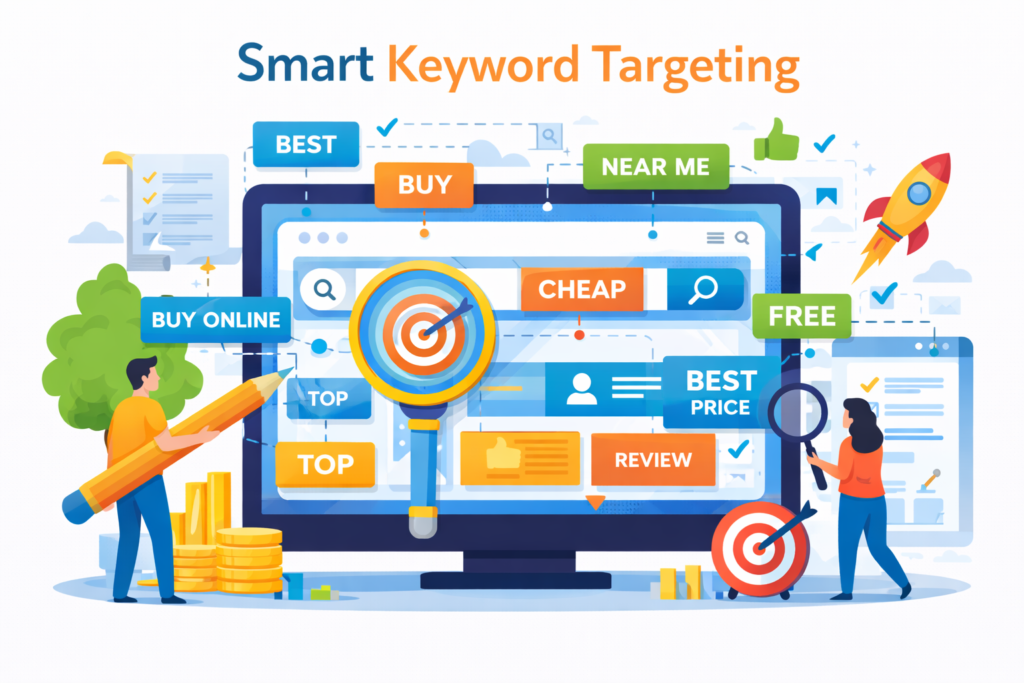
What Is Smart Keyword Targeting?
Smart Keyword Targeting is the process of selecting and placing keywords based on search intent, competition level, content relevance, and user behavior. Instead of focusing only on high-volume terms, this approach prioritizes:
Intent-based queries
Long-tail opportunities
Semantic relevance
Content depth
Topical authority
This ensures your pages attract qualified traffic that actually converts.
Why Smart Keyword Targeting Matters for SEO
Search engine algorithms have become more context-focused. They evaluate:
Content quality
User experience
Relevance to search intent
Authority and trust signals
By using Smart Keyword Targeting, you avoid keyword stuffing and create content that satisfies both users and search engines.
Key Benefits
Faster ranking for low-competition queries
Higher organic CTR
Better engagement signals
Improved content discoverability
Stronger topical authority
Understanding Search Intent for Better Targeting
To implement Smart Keyword Targeting, you must first understand why users are searching.
Types of Search Intent
1. Informational Intent
Users want to learn something.
Example: guides, tutorials, definitions.
2. Navigational Intent
Users are looking for a specific brand or website.
3. Transactional Intent
Users are ready to take action or make a purchase.
4. Commercial Investigation
Users are comparing options before deciding.
Creating content that matches these intents increases your chances of ranking higher and retaining visitors.
How to Find the Right Keywords
1. Focus on Topical Clusters
Instead of targeting a single keyword per page, build content clusters.
This strengthens semantic relevance and improves internal linking.
2. Analyze Low-Competition Opportunities
Look for:
Long-tail keywords
Question-based queries
Emerging search trends
These are essential for Smart Keyword Targeting because they help new or growing websites rank faster.
3. Use SERP Analysis
Study:
Content format ranking on page one
Word count and structure
Featured snippets
People Also Ask sections
This tells you exactly what Google prefers for a specific query.
Keyword Placement for Maximum Impact
Strategic placement plays a crucial role in Smart Keyword Targeting.
Primary Locations
Title tag
H1 heading
First 100 words
URL
Meta description
Secondary Locations
H2 and H3 headings
Image alt text
Internal anchor text
Conclusion paragraph
Proper placement improves relevance without affecting readability.
Content Optimization Using EEAT
To rank consistently, your content must demonstrate:
Experience
Share real insights, case studies, or practical examples.
Expertise
Provide accurate, well-researched information..
Authoritativeness
Build backlinks and topical depth in your niche.
Trustworthiness
Use credible data, clear structure, and transparent authorship.
When Smart Keyword Targeting is combined with EEAT, your content gains long-term ranking stability.
Semantic SEO and Keyword Variations
Modern SEO is not about repeating the same keyword.
It’s about covering the entire topic.
Use:
Synonyms
Related queries
Entity-based terms
Contextual phrases
This helps search engines understand your content holistically and improves ranking for multiple variations.
The Role of Content Structure in Rankings
A well-structured article improves both readability and crawlability.
Best Practices
Use short paragraphs
Add clear subheadings
Include bullet points
Maintain logical flow
This structure enhances the effectiveness of Smart Keyword Targeting by making your content easier to scan and index.
Internal Linking Strategy
Internal links:
Distribute authority across pages
Help search engines understand site structure
Increase user session time
Link to relevant cluster content using natural anchor text that supports your keyword strategy.
Measuring Keyword Performance
You cannot improve what you don’t measure.
Track These Metrics
Organic traffic
Keyword rankings
Click-through rate
Bounce rate
Average session duration
If a page is not performing, refine your Smart Keyword Targeting by updating search intent alignment and adding missing subtopics.
Common Mistakes to Avoid
Keyword Stuffing
Overusing the same phrase reduces readability and can harm rankings.
Ignoring Search Intent
Traffic without relevance leads to high bounce rates.
Targeting Only High-Volume Keywords
These are harder to rank and often less specific.
Publishing Without Topical Depth
Thin content cannot compete in modern search results.
Future of Smart Keyword Targeting
With AI-driven search and conversational queries rising, SEO is shifting toward:
Context over exact match
Intent over volume
Authority over isolated content
Adopting Smart Keyword Targeting now prepares your website for the next generation of search.
Conclusion
Ranking in 2026 is no longer about adding keywords—it’s about building a strategic, intent-driven content ecosystem. Smart Keyword Targeting allows you to:
Reach the right audience
Rank faster with less competition
Build long-term authority
Improve user engagement
When combined with EEAT, semantic SEO, and strong content structure, this approach creates a powerful foundation for sustainable organic growth.